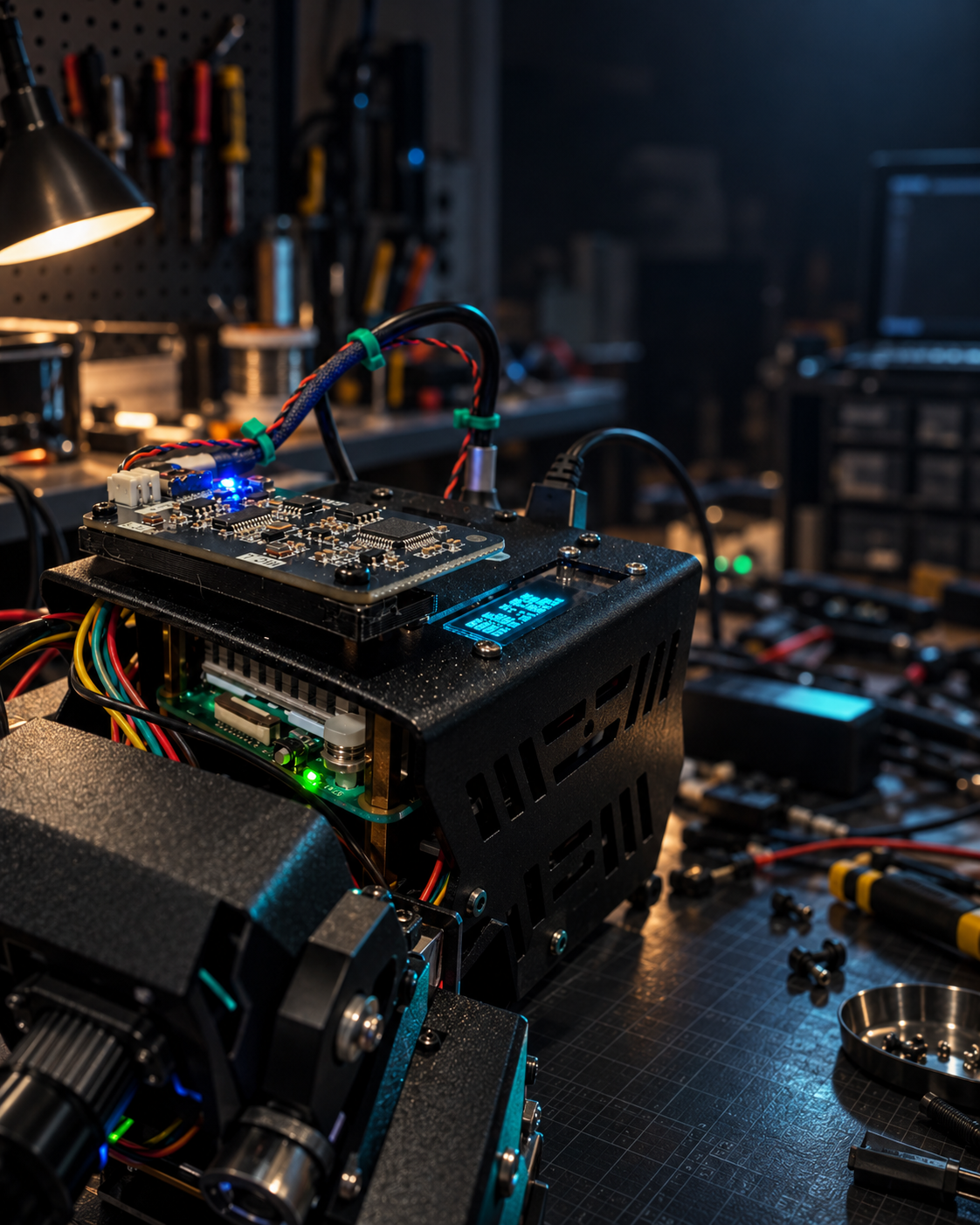
KaiBot
A compact robotics platform built to explore what happens when an AI companion can hear, see, move, and interact with the physical world.
Our Goal
KaiBot is an experiment in giving an AI companion a practical connection to the physical world. The goal is not to build a novelty robot that only follows scripted commands, but a platform where voice, vision, movement, and local autonomy can work together as one system.
The long-term direction is simple: let the AI handle intent and higher-level decisions while the robot handles fast physical tasks locally, such as navigation, tracking, obstacle avoidance, and movement. That keeps the system responsive, reduces dependence on cloud services, and creates a cleaner boundary between thinking and doing.
Voice, Vision, Movement
KaiBot brings several systems together into one physical platform. Voice provides natural conversation, the camera gives the AI a view of its surroundings, and the mobile chassis allows it to respond by actually moving through the environment.
Those capabilities are designed to work together rather than as isolated demos. KaiBot can listen, speak, observe, track people or objects, measure its surroundings, and hand movement tasks off to local behaviors running directly on the robot. The result is a platform where conversation can begin to connect with action in the physical world.
Built for Local Autonomy
KaiBot is designed so the robot can handle fast physical tasks locally instead of depending on a cloud service for every movement or correction. High-level intent can come from the cloud AI, while navigation, tracking, obstacle avoidance, distance checks, and other time-sensitive behaviors run directly on the robot’s local AI.
That separation keeps movement responsive, reduces latency, and means basic autonomy does not disappear just because an external service is unavailable. The goal is a robot that can be given a task and handle the physical details itself, rather than needing every wheel turn micromanaged from somewhere else.
Current State
KaiBot is currently in active prototype development. The core voice loop is working, the robot can hear and speak, the camera and movement systems are online, and several local behaviors have already been tested successfully.
Right now, the focus is on improving reliability, expanding the library of local skills, and tightening the handoff between high-level AI decisions and low-level robot control. It is very much a working machine, but also very much still a laboratory animal with wires hanging out of it.